Personalized Medical Care & Dedicated International Patient Concierge

Medical Guide
Botox With TargetCool Korea: Cooling Instead of Cream
Botox with TargetCool in Korea uses rapid CO2 cooling in place of numbing cream, removing the 20-minute wait. What that changes about a Botox visit.
Schedule a ConsultationBotox With TargetCool: What Temperature-Controlled Injection Changes
Medically reviewed by Dr. Kim Ki-Tae, Board-Certified Specialist in Plastic Surgery, issued by the Korean Society of Plastic and Reconstructive Surgeons
Botox with TargetCool in Korea is worth understanding as two separate things joined together. One is a familiar injectable that has not changed. The other is how it is delivered — a rapid cooling device used in place of the numbing cream most clinics apply first. TAE Plastic Surgery Clinic in Haeundae, Busan pairs the two in the service name itself, which signals that cooled delivery is standard here rather than an extra. This article explains what each part does, and what the pairing changes about an appointment.
What the injectable itself does
The cosmetic form of botulinum toxin is, in the American Society of Plastic Surgeons' description, a purified substance derived from bacteria. Injected into a muscle, it blocks the nerve signals reaching that muscle; without the signal the muscle cannot contract, and the lines its contraction produced soften. The most commonly treated areas are frown lines, forehead creases and the lines at the outer corners of the eyes, though the same society notes treatment of neck bands, heavy jaw muscles, lip lines and a gummy smile.
The clinic's own account matches that mechanism and adds the muscle-reducing applications it treats: overdeveloped facial muscles such as a square jaw, and enlarged calf or trapezius muscles. Its treatment areas run across forehead lines, frown lines, the outer eye area, jaw, chin, neck bands, shoulders and calves, with dose and placement decided from muscle strength and anatomy rather than from a standard chart.
That last point is the substance of the clinical work here. Two people with the same complaint can need very different dosing because their muscles are not equally strong, and the assessment before treatment is where that is established: which muscles are producing the concern, how active they are, how symmetrical the face is, and how much change the patient actually wants.
What TargetCool is, and what it replaces
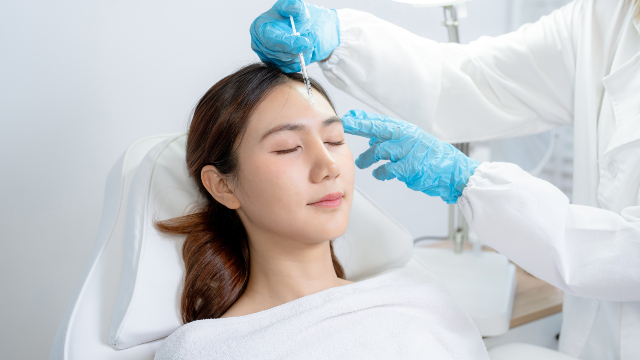
TargetCool is a rapid precision cooling device used alongside the injection. It sprays a carbon dioxide coolant to cool the skin quickly to a controlled target temperature, which the clinic states helps minimize pain during injection and reduce bruising.
The important word is "replaces". Most injection appointments begin with topical anesthetic cream, which has to sit on the skin for a while before it works. TAE Plastic Surgery Clinic states that it uses this cooling approach instead of standard anesthetic cream, and that treatment with it does not require separate anesthesia time at all. The cooling happens at the moment of injection rather than twenty minutes before it.
This is a delivery detail, not a different drug. Anyone comparing clinics on this basis should be clear about that: what changes is the experience of the appointment, not the substance being injected or what it does once it is in the muscle.
The time difference, and what it means for a visit
The clinic publishes a direct comparison. Conventional skin Botox: about twenty minutes of anesthesia time plus about ten minutes of procedure, so roughly thirty minutes in total, with more discomfort, the possibility of bleeding, bruising and swelling, and a stated recovery period of two to five days. Its cooled approach: no separate anesthesia time, about ten minutes of procedure, so about ten minutes in total, with less pain, and — in the clinic's own material — almost no bleeding, bruising or swelling, and immediate recovery.
Those are the clinic's figures for its own service, and they describe a difference in the shape of the appointment rather than in the result of the treatment. For a patient fitting a visit into a working day or into a trip, twenty minutes of waiting removed from the front of the appointment is a real convenience. It is not a claim that the injection works better, and should not be read as one.
Who it suits
The described candidates are adults concerned about facial wrinkles around the eyes, forehead, eyebrows or mouth; people with overdeveloped facial muscles such as a square jaw; people with enlarged calf or trapezius muscles; people with hyperhidrosis concerns; and people who want a non-surgical treatment with less discomfort during it.
That final group is worth naming plainly, because discomfort is one of the main reasons people postpone a treatment they have otherwise decided on. A delivery method aimed at that is addressing a real barrier rather than an invented one.
Who should avoid or postpone
The general clinical considerations are known hypersensitivity to botulinum toxin or to components of the formulation, infection at the intended injection site, certain neuromuscular disorders, and conditions or medications that raise treatment risk. Pregnancy and breastfeeding should be discussed with the treating physician, because cosmetic botulinum toxin treatment is generally deferred where adequate safety data are lacking.
Deciding this is a medical assessment rather than a checklist a reader can complete alone, and it is what the consultation exists for. A request for one goes through the clinic's online consultation route.
What happens at the appointment
The sequence the clinic describes is short and specific. Consultation and assessment of the face and its muscles; determining which muscles and which areas to treat; cleaning and disinfecting the skin; applying the cooling device to the planned injection area; injecting at the predetermined points; briefly observing the treated area; and providing aftercare instructions.
General anesthesia is not involved in a Botox treatment, and whether any additional numbing is used depends on the area and the patient. Treatment time overall depends on how many areas are being injected and where they are.
Results, and how long they last
The effect is not immediate. Muscle activity decreases gradually after injection, with visible softening of lines developing over the following days as the toxin takes effect. When the final effect appears depends on the area treated, the dose and individual response.
It is also temporary, which is the single most important thing to plan around. Repeat treatment is generally needed to maintain the result, and how long any individual holds it varies with the treatment area, the dose, how active the muscle is and individual metabolism. The American Academy of Dermatology's patient guidance on treating wrinkles makes the same point about injectable treatments generally: they are maintained rather than completed.
Risks worth knowing
Temporary redness, swelling, tenderness or bruising at the injection sites can occur. Depending on where the injection is placed and how the toxin spreads, there can be temporary unwanted muscle weakness or asymmetry — a drooping eyelid or brow, or a change in facial expression. Rare but serious complications can occur if the effects spread beyond the intended area.
The clinic's aftercare guidance is specific about what warrants prompt medical attention rather than waiting: significant weakness, difficulty swallowing, difficulty breathing, severe allergic symptoms or marked visual problems. Knowing that list before treatment is more useful than being handed it afterward.
For context on the ordinary end of that range, MedlinePlus, the consumer health service of the National Library of Medicine, explains that bruises form when small blood vessels break and blood collects under the skin, with the color changing as it is reabsorbed — which is why a bruise at an injection site looks worse on day three than on day one.
Where it sits against the alternatives
It helps to be clear about what this treatment does not compete with. A dermal filler adds or restores volume rather than reducing muscle activity, so it is not a substitute for an injectable that relaxes a muscle — the two are often discussed together and solve opposite problems. A laser or energy-based tightening treatment addresses skin quality or laxity, and does not relax the muscles that produce expression lines. A thread treatment provides mechanical lifting of tissue rather than temporary neuromuscular relaxation.
The clinic sets out those distinctions itself, and they matter at the consultation stage more than at the booking stage. A patient whose forehead lines appear only when they raise their eyebrows has a muscle problem. A patient whose lines are visible at rest has, at least partly, a skin problem, and may be better served by a different treatment or by a combination. Botulinum toxin can be considered alongside other aesthetic treatments where it is clinically appropriate, but which combination makes sense is determined after assessment rather than assembled in advance.
Asking which category your own concern falls into is a more productive opening question than asking how many units you need, and it is the one an experienced examiner will want to answer first.
Aftercare, and what to avoid
The clinic asks patients not to manipulate the injection sites unnecessarily immediately afterward, and generally to avoid touching or massaging the treated area, strenuous exercise and heat exposure for about twenty-four hours. Its written guidance covers the specific timeline for the area treated.
Beyond that there is little to do. The absence of a recovery period is much of the point, and where the cooled delivery is used the clinic describes recovery as immediate rather than as a period to plan around. Wider background on how the practice operates is set out on the about the clinic page.
The Bottom Line
- Botulinum toxin blocks the nerve signal to the injected muscle, so the muscle cannot contract and the lines it produces soften — the drug is unchanged by how it is delivered.
- TargetCool sprays carbon dioxide coolant to cool the skin rapidly to a controlled temperature, and the clinic uses it in place of standard numbing cream.
- Because there is no waiting for cream to work, the clinic states its total visit time is about ten minutes against roughly thirty for a conventional approach.
- Dose and placement are decided from muscle strength and anatomy, which is why the assessment matters more than the product name.
- The effect develops over days and is temporary; repeat treatment is needed to maintain it.
Frequently Asked Questions
Is TargetCool a different kind of Botox?
No. It is a cooling device used at the moment of injection. The injectable is unchanged; what changes is how the skin is prepared and how the injection feels.
How does the cooling work?
It sprays a carbon dioxide coolant that cools the skin rapidly to a controlled target temperature. The clinic states this helps minimize pain during injection and reduce bruising, and that it is used instead of standard topical anesthetic cream.
Why is the appointment shorter?
Because the twenty-minute wait for numbing cream is removed. The clinic's comparison puts a conventional visit at roughly twenty minutes of anesthesia time plus ten minutes of procedure, against about ten minutes in total for its cooled approach.
Which areas can be treated?
The clinic treats forehead lines, frown lines, the outer eye area, the jaw, chin, neck bands, shoulders and calves. Dose and placement are decided from muscle strength and anatomy rather than a fixed protocol.
How soon will I see a change, and how long does it last?
The effect develops progressively over the days after injection rather than immediately. It is temporary, and how long it lasts varies with the area, the dose, how active the muscle is and individual metabolism, so repeat treatment is needed to maintain the result.
What are the risks?
Temporary redness, swelling, tenderness or bruising at the injection sites, and — depending on placement and spread — temporary muscle weakness or asymmetry such as a drooping eyelid or brow. Rare serious complications can occur if effects spread beyond the intended area.
What should prompt me to seek medical attention?
Significant weakness, difficulty swallowing, difficulty breathing, severe allergic symptoms or marked visual problems. These warrant prompt attention rather than waiting for the next scheduled contact.
This article is for general informational purposes and does not constitute individualized medical advice, and it is not a self-diagnosis tool. Care described here is delivered in the Republic of Korea under Korean medical licensure rather than United States licensure, and the clinic is closed on Sundays and observes a daily lunch break, which affects scheduling for short international trips. Speak with a qualified plastic surgeon about your own circumstances before making any treatment decision.
More Articles
Continue reading our clinical guides.
XERF Skin Tightening Korea: Dual Radiofrequency Depth
XERF skin tightening in Korea uses two monopolar radiofrequencies at 6.78 MHz and 2 MHz with three-stage depth control. How it works at TAE in Busan.
Learn More
Trinity Breast Surgery Korea: A Combination Approach
Trinity Breast Surgery at TAE Plastic Surgery Clinic combines customized implant selection with fat transplantation and contouring in one surgical plan.
Learn More
Skin Booster Korea: Matching the Booster to Your Skin
Skin booster Korea explained: how boosters differ from fillers, what the DoubleTite RF-plus-booster approach involves, and how the product is selected.
Learn More